


Tower Rush Demo
 FUN Demo
Pros
- The Key, Salt and Hash Code interface described by SlotCatalog gives a defined input-and-comparison task.
- Round history connects an accepted stake to its final credit and balance movement.
- My reconnection test preserved the same round and applied its payout only once.
Cons
- A delayed animation can show a different stage from the server's settled state.
- A successful Cashout can return less than your stake, leaving a net loss.
- Hash comparison, settlement arithmetic and payment verification answer separate questions; none predicts the next floor.
Tower Rush fairness and result verification starts with identifying the claim you want to check: a hash calculation concerns particular inputs, a round record concerns an accepted wager, and a balance reconciliation concerns money or FUN credited to the correct wallet.
Tower Rush fairness and result verification at each level
Galaxsys describes Provable Fairness as a feature of the original game, while the Key/Salt interface described by SlotCatalog and my reconciliation of accepted rounds address specific checks within the broader question of fairness.
The provider's B2B wording is “100% Provable Fairness”; the percentage belongs to that feature statement, while each result check below has a defined object and comparison.
| Check | Information used | Question answered |
|---|---|---|
| Hash comparison | Key, Salt and the displayed Hash Code | Does the checker produce the same hash for the specified inputs? |
| Outcome replay | Commitment, seed, nonce, serialisation, digest and game-specific result mapping | Does the complete calculation reproduce the outcome under that protocol? |
| Round settlement | Round ID, accepted stake, final payout and balance | Was this accepted round accounted for consistently? |
| External payment | Operator withdrawal record and receipt outside the casino | Did that separate withdrawal reach its destination? |
The last row matters in Bangladesh because a BDT amount on an in-game Cashout button and a payment received outside an operator are different events. Cashout closes the tower and credits the game balance. An external withdrawal then follows the operator's payment process. A successful result check should name which event it actually covers.
What Key, Salt and Hash Code refer to
Key and Salt are the input labels in the shield-panel route described by SlotCatalog, with Hash Code supplying the comparison value; the shield sits in the upper-right corner in that description, rather than defining a universal menu layout for every operator.
For that route, open the shield panel, copy the Key and Salt exactly and enter them in the checker described for that route. Compare its output with the displayed Hash Code. Keep the complete values tied to the selected result. Mixing fields from different rounds changes the calculation, even when both sets came from the same game.

A complete outcome replay connects the commitment to the revealed inputs. It also applies the relevant protocol version, byte serialisation and digest-to-outcome mapping. Serialisation is the exact representation of inputs for calculation. The mapping turns the calculated value into a game event. Multiplying floor coefficients or checking a balance addresses a different part of the result.
If you perform both checks, match the hash comparison and financial record to the same round. The hash comparison connects the calculation inputs and output, while the financial record shows how the accepted bet was settled.
How to reconcile a round with your balance
Your own history, accepted stake and final credit provide the practical route for checking settlement.
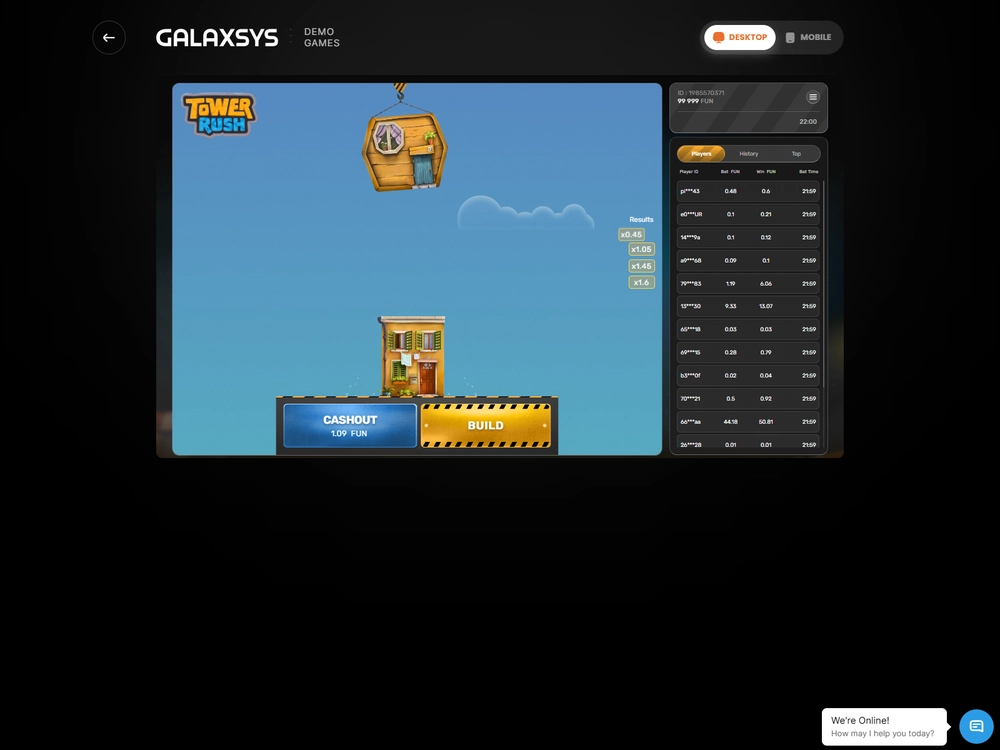
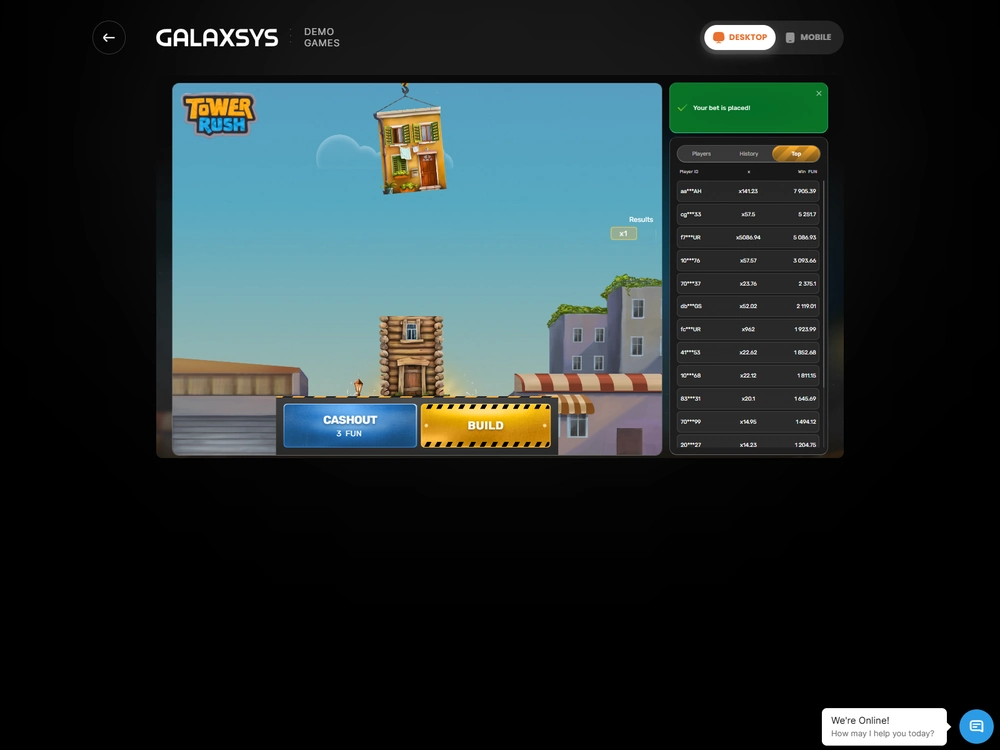
In the official demo, Players, History and Top are separate panels. The public list includes Player ID, BetFUN, WinFUN and Bet Time. Those rows describe the listed players' activity. Another player's entry is neither a second wager in your tower nor a substitute for your own record.
The game runs an individual tower with one active stake. Build can place another floor within that already accepted round, so counting every floor as a new paid bet would inflate your turnover. Likewise, a changing Cashout amount is the current potential payout. It becomes a credit when the round reaches its applicable final settlement.
Follow the same round from acceptance to credit
Open your own history and trace one accepted round through to its final balance movement, retaining the displayed currency throughout: FUN remains demo currency, while a BDT cash entry belongs to the operator wallet and account used for that session.
- Identify the game and mode. Check Tower Rush, Galaxsys and the original game's rules. Keep Tower Rush 2 and Branded separate. Confirm whether the balance is FUN or the operator's cash currency.
- Locate the accepted round. Go to History or your own betting history. Match the round ID and accepted stake, using the recorded time to help locate the entry rather than substituting time for identity.
- Separate the debit from later actions. Find the single stake deduction. Further Build actions in the same tower and automatic bonus-floor actions do not turn that accepted stake into several wagers.
- Read the final status and payout. Check the confirmed Cashout, collapse, protected Frozen amount or refund, as applicable. Keep an open or pending round separate from a settled loss.
- Reconcile the balance. For an ordinary settled round, subtract the stake from the starting balance and add the final gross payout. Check the resulting balance against the account entry.
- Retain the specific discrepancy. If the amounts differ, keep the round ID, stake, currency, final status and relevant balance entries together for the operator's support team. Distinguish a missing credit from a disputed calculation or an external withdrawal.
The identity check comes first because a familiar name is not the whole product definition. The original demo uses game ID 90. Operator catalogues use their own identifiers, so that demo number should not be imposed on every operator's catalogue. The original-game identification guide covers the name, provider and configuration checks in detail.
My BDT settlement check in Bangladesh
I reconciled 13 accepted towers in a 1win cash session on my Xiaomi 15 Ultra, running Android 15 and HyperOS 2 through the operator's launcher. The account was registered for Bangladesh, the wallet used BDT, and each accepted stake was BDT 380.00. I matched the round entries to their debits, final payouts and resulting balances.
| Round in session | Accepted stake | Gross payout | Net result | Balance after settlement |
|---|---|---|---|---|
| First, Cashout at ×0.5 | BDT 380.00 | BDT 190.00 | −BDT 190.00 | BDT 2,850.00 |
| Second, Cashout at ×1.4 | BDT 380.00 | BDT 532.00 | +BDT 152.00 | BDT 3,002.00 |
| Third, collapse without Frozen | BDT 380.00 | BDT 0.00 | −BDT 380.00 | BDT 2,622.00 |
| Tenth, Cashout at ×1 | BDT 380.00 | BDT 380.00 | BDT 0.00 | BDT 3,116.00 |
The first row contains a payout and a loss at the same time. I began with BDT 3,040.00. The accepted stake reduced the balance to BDT 2,660.00, and the BDT 190.00 credit brought it to BDT 2,850.00. The account received money, but it finished below its starting balance. Gross payout and profit must therefore be read separately.
Across the complete session, stakes totalled BDT 4,940.00 and gross payouts totalled BDT 5,149.00. The difference was +BDT 209.00. Starting cash of BDT 3,040.00 therefore reconciled to BDT 3,249.00 before the external withdrawal. That reconciliation checks the session's recorded money movements; it does not turn one favourable session into a promise about later play.
Nine of the 13 rounds returned a positive payout. Only seven returned more than the stake. That distinction prevents a list of credited rounds from overstating profitable outcomes. I used the final settlement amount in the reconciliation. This BDT configuration rounded money down to BDT 0.01 after the final product; a rounded display multiplier was not the calculation's starting point.
Tower Rush operator reviews
Six completed Bangladesh BDT tests. Scores and payment results reflect the tested accounts.
-

BDT access score7.15/10
- 96.55% configured RTP.
- 891 BDT received via bKash after a 9 BDT deduction.
-

BDT access score7.40/10
- 96.69% configured RTP.
- 1,900 BDT received via Nagad with no deduction after identity and address checks.
-

BDT access score7.15/10
- 96.19% configured RTP.
- 2,084.25 BDT received via Nagad after a 15.75 BDT withdrawal fee.
-

BDT access score7.15/10
- 97.00% configured RTP.
- 1,200 BDT received via bKash in 6 min 27 sec. The deposit had a 30.36 BDT external charge.
-

BDT access score7.40/10
- 96.65% configured RTP.
- 1,500 BDT received via bKash in full. The deposit had no external charge.
-

BDT access score7.40/10
- 96.33% configured RTP.
- 500 BDT received via bKash in full after identity and address checks.
The session's observed return of 104.2308% describes its realised payouts relative to stakes, whereas the configuration's 96.69% RTP is a theoretical parameter, with the distinction and configuration ranges explained in RTP and payout maths.
Account for bonus floors only once
Frozen, Temple and Triple Build affect the current tower's settlement. They do not create separate paid rounds. In my FUN checks, a 100 FUN stake with 500 FUN protected by Frozen returned the protected amount after a later collapse. A separate check continued from the same protected amount to a 1,000 FUN Cashout. Its final payout was 1,000 FUN: adding the protected 500 FUN again would overstate the credit.
The same principle applies to intermediate bonuses. I checked a Temple sequence in which 150 FUN became 225 FUN after ×1.5, followed by one final credit of 225 FUN. In a Triple Build sequence, 120 FUN passed through ×1, ×1.5 and ×2 to reach 360 FUN, still against a single 100 FUN stake. Adding every intermediate amount would misstate the result.
What a timeout or late Cashout means
A timeout describes the client's communication state; the server's accepted round and settlement determine the financial result.
Slow connections and device performance can delay the visible update. After a connection drop, restore the connection and check the server’s round state. The stake is debited only when the server accepts the bet. Check the result of an accepted round before treating the interruption as a loss or starting another paid cycle.
I kept request, acceptance and credit separate in the FUN checks below, each starting from 1,000 FUN with a 100 FUN stake so the closing balances can be compared directly without mixing demo units, BDT transactions or external payments.
| Event | Accepted result | Closing balance | What the record distinguishes |
|---|---|---|---|
| Confirmed Cashout after ×1.6 and ×1.45 | 232 FUN gross | 1,132 FUN | One stake and one final credit |
| Cashout sent after server collapse | 0 FUN gross | 900 FUN | Rejected late command, without a second debit |
| Connection restored after 18 seconds | Same round, 180 FUN gross | 1,080 FUN | Repeated response leaves the balance unchanged |
| Software malfunction and void | 100 FUN stake refunded | 1,000 FUN | Refund restores the stake; it is not profit |
| One hour of inactivity after acceptance | Registered settlement of 150 FUN | 1,050 FUN | Automatic completion under the inactivity rule |
During the reconnection check, I restored the same round ID and completed Cashout at ×1.8. The balance reached 1,080 FUN. Reading the response again left it unchanged. There was no second 180 FUN credit. This is the financial distinction to preserve after a repeated response: reading the same completed event again does not make it another payout.
The void case requires a different classification. Its stake deduction and equal refund cancel each other. Keep that refunded wager outside settled betting turnover and gross payouts. The inactivity branch follows another rule: after one hour without reconnection, the accepted round closes and its registered payout is credited. That is automatic completion rather than a manually accepted Cashout.
Keep fairness, access and prediction separate
Verification of a completed round is retrospective.
Before a bet, you can read the rules, permitted stake and public history. The completed record adds your accepted amount, round identity and gross payout. Each belongs to its own point in the process. A future revealed seed does not become advance knowledge merely because a checking interface exists.
Similarly, a provider's supply licence, an operator's permissions and the publisher's role concern different entities. A matching balance or hash does not grant permission to use an operator in Bangladesh. The licensing and legal context sets out those distinctions; Galaxsys and the game's origin explains the provider relationship.
Use the predictor and scam-claims guide when a service presents historical results as a way to know the next floor; verification instead connects the correct inputs or financial entries to the result they describe.
Check the record that matches your question
Tower Rush fairness and result verification is most useful when its conclusion names the exact check: the Key/Salt hash comparison, a complete outcome calculation or a reconciled accepted round. My 13-round BDT session and the FUN interruption checks illustrate settlement accounting, with server confirmation and one credit per completed event. They do not provide a forecast of later results.
Open the Methodology for the checking approach, or identify the original game before comparing records from different versions.
Frequently asked questions
Does a matching Hash Code guarantee my next win?
No. It is the output of a comparison for specified inputs. Checking a completed result does not predict the next floor, guarantee profit or establish that an external withdrawal will succeed.
Why can Cashout show money while my balance is lower?
The accepted stake is deducted before the final credit. During an active tower, the button shows the potential payout at that stage. Compare your starting balance, stake and confirmed final credit, rather than treating the changing button amount as money already paid.
Is a payout below the stake a settlement error?
It can be a valid result. Floor coefficients can reduce the current amount. In my BDT session, a BDT 380.00 stake cashed out at ×0.5 and returned BDT 190.00, producing a net loss of BDT 190.00.
Should I press Build again after a connection timeout?
Restore the connection and check the existing round first. After server acceptance, a timeout does not erase the stake. In my reconnection check, the same round returned one final payout and repeating the response did not change the balance again.
Can I use demo history to verify a BDT transaction?
Use the history belonging to the transaction's own wallet and mode. FUN records describe virtual-unit rounds. A BDT cash settlement belongs to the operator account that accepted it, and an external withdrawal has a separate payment record.