


Tower Rush Demo
 FUN Demo
Pros
- Cashout lets you end the tower after a successful floor.
- Frozen Floor protects an accumulated amount within that round.
- Official FUN play lets you examine the controls without a deposit.
Cons
- A successful floor can carry a multiplier below ×1.
- Reaching the demo payout cap does not automatically end the tower.
- Increasing stakes after losses can encounter a stake cap or exhaust the available balance.
No strategy, website or author can guarantee a win, profit or any particular gambling result. This analysis does not provide instructions for winning or recovering losses. It explains decisions about spending, exposure and risk; those decisions do not remove the possibility of loss.
Tower Rush strategy and risk starts with the next Build
Continuing puts the tower's current outcome through another floor, and a successful placement does not always increase its value. Original Tower Rush by Galaxsys uses successive multipliers rather than one multiplier that only rises. One distinction is central to Tower Rush strategy and risk: a displayed payout is different from money credited after a confirmed Cashout.
I saw that distinction in the official mobile demo on my Xiaomi 15 Ultra. One 100 FUN stake passed through multipliers of ×0.4 and ×0.95, then returned 38 FUN after Cashout. Both floors were successful. The completed tower still lost 62 FUN. Another returned 45 FUN from a 100 FUN stake. Counting either as a profitable round would misdescribe the result.
Frozen Floor changes the downside within its tower. In the 100 FUN example, freezing at ×5 protects 500 FUN if a later floor collapses. A subsequent confirmed Cashout at ×10 pays 1,000 FUN in total; the frozen amount is not added again. Protection applies to the accumulated amount under that feature's rules, rather than to every future stake.
The payout ceiling matters just as much. The demo cap is 10,000 FUN per tower. A raw result of 12,600 FUN is capped at 10,000 FUN, yet construction can continue. Further building cannot increase that capped payout and can still end in a loss under the round's rules. The ceiling itself is not a cashout command.
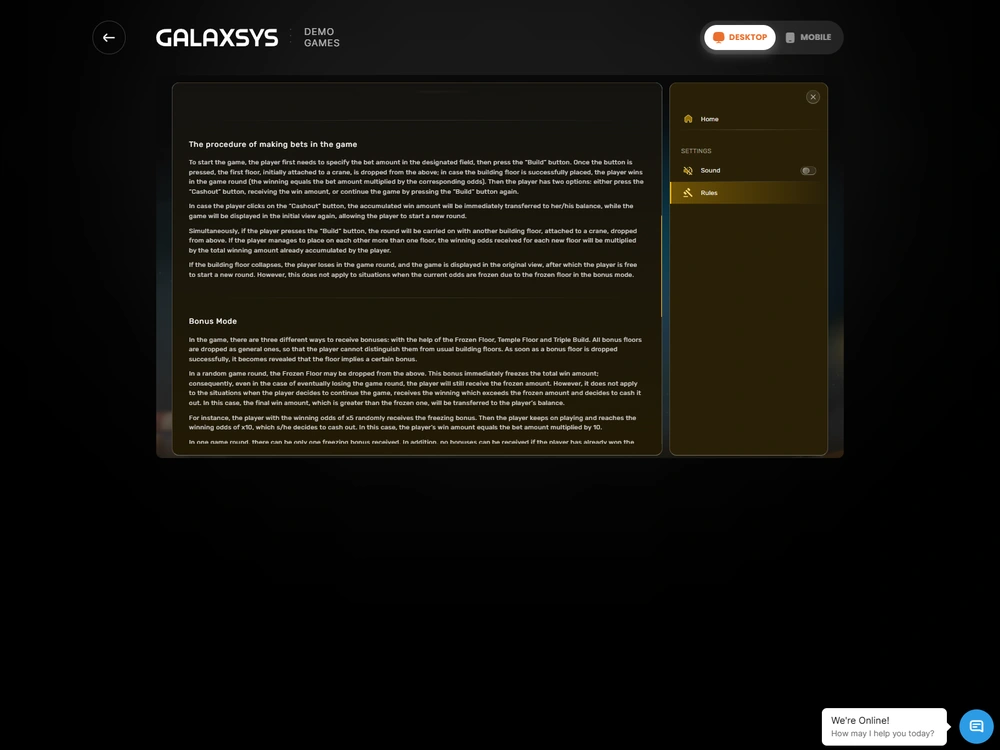
There is one active stake per individual tower. A two-panel crash formula therefore cannot be treated as a second betting option here, and the Players list is not another panel belonging to you. See the rules and controls for the complete round sequence.
Compare the same turnover before comparing expected losses
Expected loss is comparable only when the turnover and return assumptions are comparable. Turnover, written as T, means the sum of accepted, settled stakes. Gross payout includes returned stake; net result is gross payout minus turnover. Depositing money does not itself add to T.
For a known applicable return r and turnover fixed in advance, expected gross payout is r × T, while expected net is (r − 1) × T. The following controlled comparison uses 10,000 BDT of turnover in each case, with no bonuses, fees or stopping rule changing that amount.
| Scenario | Fixed turnover | RTP | Expected gross payout | Expected loss |
|---|---|---|---|---|
| A | 10,000 BDT | 97.00% | 9,700 BDT | 300 BDT |
| B | 10,000 BDT | 96.17% | 9,617 BDT | 383 BDT |
Scenario A has an expected loss 83 BDT lower than B, a reduction of 21.6710% relative to B's expected loss. The RTP difference is 0.83 percentage points. Those figures describe the comparison's expectation, not an extra 83 BDT promised to a player.
Equal opening balances do not produce equal turnover automatically: stake size, repeated use of payouts and stopping decisions all affect how much is wagered. For Bangladesh readers, the BDT label keeps the monetary scale clear; it does not turn these scenarios into available operator settings. The RTP explanation separates game configurations and payout calculations.
What the controlled stake comparison actually shows
The three approaches produced different exposure and outcome distributions, with negative mean net results in every case. This is a separate two-outcome model: each stake b pays gross 2b with probability 0.485, or zero with probability 0.515. Its theoretical return is 2 × 0.485 = 0.97, leaving a 3% house edge. These are assigned model probabilities, not Tower Rush floor probabilities.
Each approach used 12,100 independent runs, a starting balance of 1,000 BDT and a maximum of 100 cycles per run. Matching runs used the same underlying random inputs across the three approaches. That makes their responses to the inputs comparable without making the approaches independent of one another.
Stake rules and stopping conditions
The comparison changed the stake rule while retaining the same stopping conditions. A run ended after settlement at a balance of 600 BDT or less, at 1,500 BDT or more, or after reaching the cycle limit. The stake cap was 100 BDT. An unaffordable next permissible stake also ended the run, without a hidden all-in substitution or a negative balance.
The three rules were:
- Fixed: 10 BDT for each cycle.
- Balance fraction: 2% of the remaining balance, rounded down to whole BDT.
- Linear increase: start at 10 BDT, add 5 BDT after a net loss, reset to 10 BDT after a win, and observe the 100 BDT cap.
These are comparison inputs, not personal stake recommendations. The 600 BDT stopping balance represents a loss of at least 400 BDT from the starting bank. It does not mean a 400 BDT fall from whichever peak the run reached. Similarly, the 1,500 BDT threshold defines a stopping event; it says nothing about whether that event will occur.
| Approach | Mean turnover, BDT | Mean net, BDT | Standard error of mean net, BDT | 5th / 50th / 95th percentile net, BDT | Loss-limit stops |
|---|---|---|---|---|---|
| Fixed 10 BDT | 999.9934 | −27.9124 | 0.9057 | −200 / −20 / +140 | 1 of 12,100 (0.0083%) |
| 2% of balance | 1,883.8493 | −52.7790 | 1.6866 | −332 / −61 / +289 | 207 of 12,100 (1.7107%) |
| Linear increase | 1,485.2727 | −42.2636 | 1.5159 | −400 / −30 / +210 | 670 of 12,100 (5.5372%) |
Read the spread alongside the mean
The fixed-stake approach had the lowest mean turnover and the least negative mean result in this model. The fraction rule generated substantially more turnover, while the linear rule reached the loss limit most often. Calling one approach profitable because its upper percentile is positive would discard the losing outcomes and the negative mean.
The percentile columns show positions in the sorted final results, using the nearest-rank method. The middle value is the median. The outer values are not hard bounds: some runs ended below the fifth percentile and some above the ninety-fifth. Their role is to show how widely outcomes can differ under the same stated conditions.
Standard error measures the precision of the estimated mean across the model's runs. It does not describe the likely loss of one player. All three arrays had zero runs ending for lack of an affordable next stake; the one-sided 95% upper bound associated with that zero count is 0.0248%. This statistical bound belongs to the model and its event definition.
Tower Rush operator reviews
Six completed Bangladesh BDT tests. Scores and payment results reflect the tested accounts.
-

BDT access score7.15/10
- 96.55% configured RTP.
- 891 BDT received via bKash after a 9 BDT deduction.
-

BDT access score7.40/10
- 96.69% configured RTP.
- 1,900 BDT received via Nagad with no deduction after identity and address checks.
-

BDT access score7.15/10
- 96.19% configured RTP.
- 2,084.25 BDT received via Nagad after a 15.75 BDT withdrawal fee.
-

BDT access score7.15/10
- 97.00% configured RTP.
- 1,200 BDT received via bKash in 6 min 27 sec. The deposit had a 30.36 BDT external charge.
-

BDT access score7.40/10
- 96.65% configured RTP.
- 1,500 BDT received via bKash in full. The deposit had no external charge.
-

BDT access score7.40/10
- 96.33% configured RTP.
- 500 BDT received via bKash in full after identity and address checks.
A loss-limit stop with money remaining is a different event from being unable to fund the next stake. Neither label should be swapped to make a result sound safer or worse.
There is also a distinction between fixing turnover before play and selecting a completed run afterwards. Taking one successful run's realised turnover and multiplying it by −3% does not establish that run's conditional expected result. The table reports observed model averages alongside the stopping rules that shaped them.
Why loss streaks put pressure on progressions
A run of losses can be common over many opportunities even when one specified block looks unlikely. With the model's loss probability of 0.515, five losses in a particular block have probability 3.6227%. At least one five-loss streak within 100 trials has probability 84.9437%; overlapping windows cannot be counted as independent events. The mean waiting time to the first such streak is 54.852538 trials.
The distinction matters when examining doubling claims. Starting at 10 BDT produces the sequence 10, 20, 40 and 80 BDT. Four losses total 150 BDT. The next proposed stake, 160 BDT, already exceeds the model's 100 BDT cap, despite a remaining balance of 850 BDT.
Remove that cap and the balance still creates a boundary. Six successive losses total 630 BDT, leaving 370 BDT from the original 1,000 BDT. The proposed next stake of 640 BDT cannot be funded. This is the progression's escalating commitment, not evidence that a recovery win is due.
What my 13-tower Bangladesh session can tell you
My session at 1win finished with a positive result, but it cannot establish the next tower's outcome or the game's floor distribution. I used original Tower Rush in BDT on a Xiaomi 15 Ultra through the 1win Android launcher, placing 380 BDT on each of 13 completed towers without activating a welcome bonus.
| Measure | Result | What it counts |
|---|---|---|
| Turnover | 4,940 BDT | Thirteen accepted stakes |
| Gross payouts | 5,149 BDT | Completed tower payouts, counted once |
| Net result | +209 BDT | Gross payouts minus turnover |
| Towers paying anything | 9 of 13 | Gross payout above zero |
| Profitable towers | 7 of 13 | Gross payout above the 380 BDT stake |
| Largest completed-tower drawdown | 532 BDT | Fall from a prior settled-balance peak |
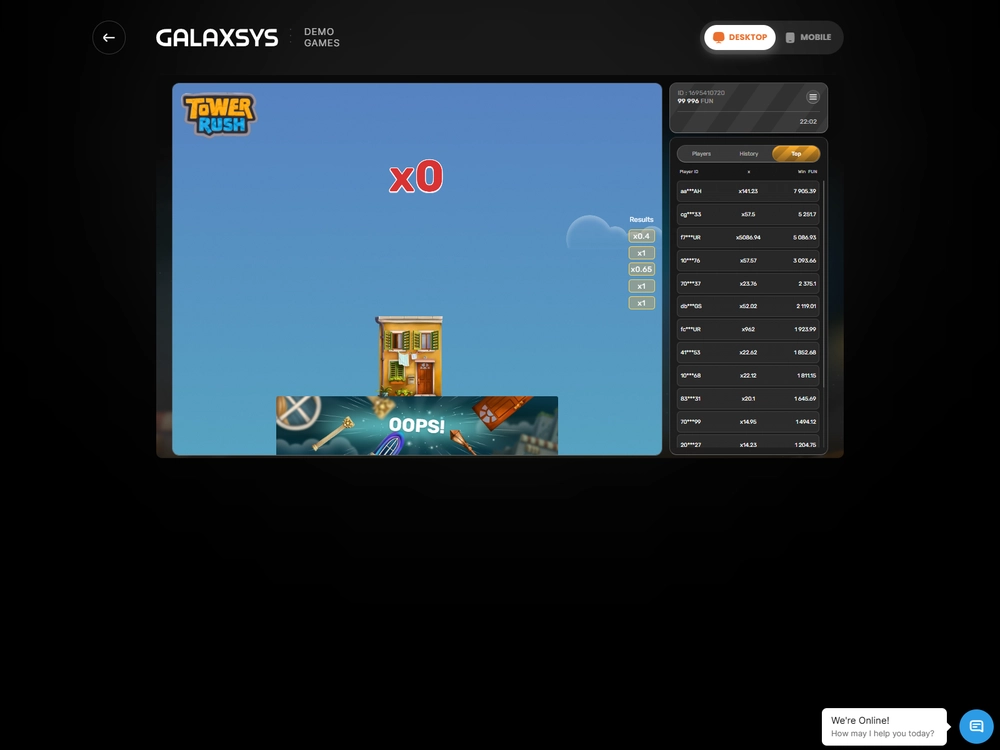
The first tower returned 190 BDT, so it paid something while losing half the stake. Another returned exactly 380 BDT and broke even. Four returned zero. Seven finished in profit. That separation explains why the payout frequency, 69.2308%, is higher than the profitable-tower frequency of 53.8462%.
The observed return was 104.2308%, against a configured theoretical RTP of 96.69%. Applying the latter to a turnover fixed at 4,940 BDT gives expected gross of 4,776.49 BDT and expected net of −163.51 BDT. The actual +209 BDT remains the result of this short session; it does not replace the theoretical parameter.
Its longest net-loss streak was only one tower. That makes a poor stress test for a system designed around surviving consecutive losses. Even the profitable-tower proportion has a broad 95% Wilson interval, 29.1438% to 76.7939%, under an independent, identically distributed Bernoulli assumption. The interval concerns that proportion, not RTP.
The 532 BDT drawdown measures balances after completed towers. A snapshot immediately after a stake debit answers a different question and may show a deeper fall. Keeping the measurement point consistent prevents a balance animation from being mistaken for a settled session result.
Apply limits to spending, time and settled results
A personal limit determines when you stop committing new money. It does not reverse an accepted stake or guarantee settlement exactly at your chosen threshold. In the controlled limit example, a 400 BDT loss threshold was crossed at a 410 BDT net loss, leaving 590 BDT; the limit then prevented the next stake.
Use the following checks to keep those decisions explicit:
- Write down your starting amount and a separate loss limit. Keep the reference point fixed; do not redefine it after a winning tower.
- Record turnover separately from deposits. Add accepted, settled stakes, including stakes funded from previous payouts.
- Set an end time and include pauses. A pause reduces opportunities to place more stakes; it does not improve the odds of the next floor.
- Check the settled result before another commitment. If a round is pending after a connection problem, restore that round's state first.
- Stop when the chosen boundary is reached. Treat an urge to increase the budget to recover a loss as a reason to use the site's responsible-gambling measures.
The separate pace example makes the turnover effect concrete: 90 accepted cycles at 10 BDT create 900 BDT of turnover. Thirty skipped opportunities create none. At the example's assumed 3% edge, expected loss on that fixed turnover is 27 BDT. Its 60-minute window includes 14 minutes of pauses; those figures describe the scenario, not your likely play rate.
Keep the conclusion tied to the evidence
Tower Rush strategy and risk analysis is useful for understanding exposure: taking an available payout, continuing a tower, changing stake size and stopping each have different consequences. The controlled comparison showed negative means and different loss patterns; my positive Bangladesh session remained a short observation. Limits can reduce further commitments, but cannot guarantee profit. Read the methodology alongside the RTP assumptions before interpreting any strategy table.
Questions about strategy and limits
Does cashing out earlier guarantee a profit?
No. A successful floor may return less than the original stake, as the 45 FUN payout on a 100 FUN stake illustrates. Cashout settles the available result; its label does not mean that the result is profitable.
Is the fixed 10 BDT model result a recommended stake?
No. It is a comparison rule in a separate two-outcome model. The result depends on that model's starting balance, probabilities, stopping conditions and cycle limit. It does not identify a universally suitable Tower Rush stake.
Can the history identify the next successful floor?
The 13-tower session describes completed outcomes and cannot predict the next one. Successful examples selected from a history are not a forward prediction test. See the explanation of predictors and misleading claims.
Does a loss limit close an unfinished tower?
A personal session limit stops the next stake after the accepted tower is settled. It does not undo the current round. During a network interruption, restore the accepted round and check its confirmed result before interpreting the balance or taking another action.