

Tower Rush Demo
 FUN Demo
Pros
- The official FUN mode lets you practise the controls without an operator account or deposit.
- Each tower uses one accepted stake; further Build actions do not charge for individual floors.
- Frozen Floor protects a defined accumulated amount through a later collapse.
Cons
- Successful placement can still leave the payout below your stake.
- Reaching the payout ceiling does not automatically close the tower or remove the risk of collapse.
- A Cashout request received after the server has registered collapse is too late.
Tower Rush rules and gameplay revolve around a choice after each successful floor: collect the available amount or attempt another placement. Galaxsys's original HTML5 game uses an individual tower with one active stake, so other players' results do not determine when your round ends.
For readers in Bangladesh, the useful starting point is the FUN indicator: these are virtual units, separate from a BDT account balance. I used the official mobile demo on my Xiaomi 15 Ultra in Bangladesh without registering or depositing. Its starting balance was 100,000 FUN.
Tower Rush rules and gameplay from stake to settlement
A round starts when the server accepts your initial Build action and ends when its result is settled through Cashout, collapse or the applicable completion rule.
The crane and floors show the progress of that single round. There are no reels, paylines or a shared countdown flight to join. The first accepted Build commits the stake. Subsequent Build actions continue the same tower, and each successful ordinary floor applies its coefficient to the current amount.
Tower Rush building controls before a round
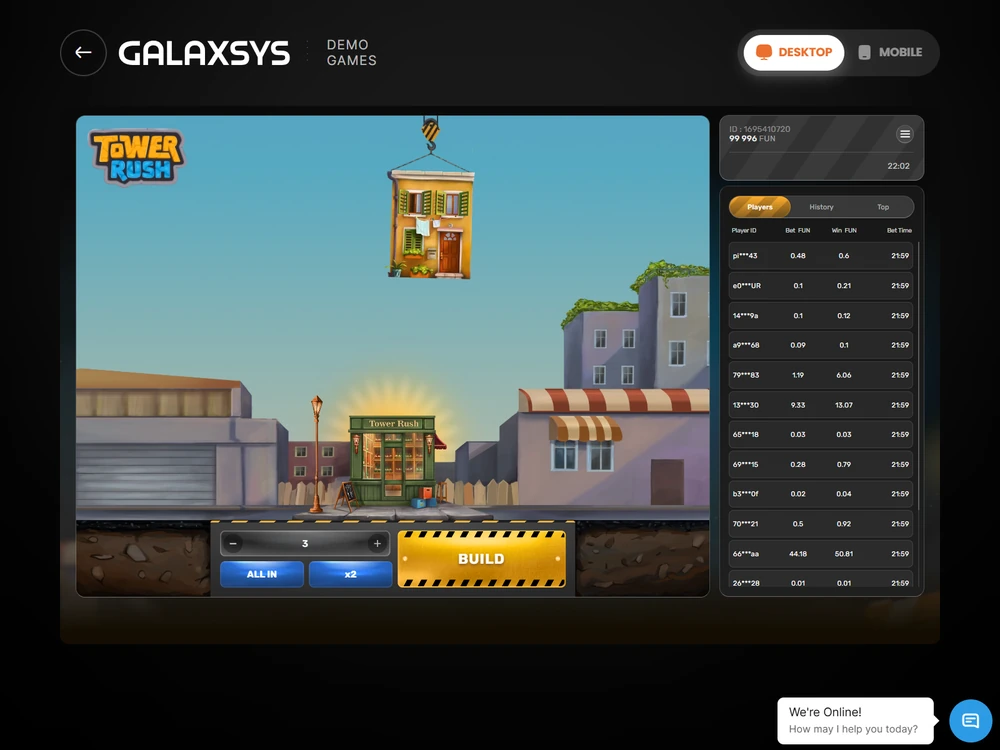
The Tower Rush building controls consist of a stake field, Build and Cashout, alongside balance and result information that changes with the round's state.
Before pressing a button, distinguish the amount you are committing from the amount you could collect. The stake field belongs to the new tower; the available Cashout amount belongs to the accepted tower already in progress. Changing the stake field does not reprice an existing tower or its Frozen protection.
- Stake field: enter an amount within the official demo's 1–100 FUN range and your available balance.
- Build: submit the initial stake while idle, or request another floor during an open tower.
- Cashout: collect the available server-confirmed amount after a successful floor.
- x2 and ALL IN: stake controls; they are not an automatic sequence of rounds.
- Players, History and Top: separate information panels. The public player list is not a second betting panel for your tower.
On desktop, Home → Settings contains Sound and Rules, and the rules can be exported as a PDF. Opening Rules does not change the balance. I also used Tab to move between the stake field, Build and Cashout; Enter applied the action on the currently active button.
Play one FUN tower step by step
To practise how a Tower Rush round works, start in the official virtual mode and follow the accepted action through to its final balance change.
- Open the official demo page, select the original Tower Rush by Galaxsys and check that the balance is labelled FUN.
- Go to Rules and check the stake range and payout ceiling. Return to the game with no unfinished tower awaiting a result.
- Enter a valid stake and check the displayed amount before selecting Build. Wait for acceptance and the first floor's result.
- After a successful placement, read the available Cashout amount. Select Cashout to end the tower, or Build to attempt another floor with the same accepted stake.
- If a special floor activates, let its sequence finish and read the resulting amount and any Frozen protection before making the next available decision.
- After the tower ends, open History and match the round identifier, stake and payout to the balance change. Begin another paid cycle only after the current one has finished.
Entering a stake is still preparation. An invalid amount is rejected without a debit, while an accepted initial Build creates the stake obligation; closing an input form afterwards does not cancel that accepted round.
Tower Rush game play after the first floor
Tower Rush game play continues within the existing tower whenever you choose Build after a successful placement, with no additional stake charged for that ordinary floor.
Each placement produces a new decision state. A successful floor creates an available amount, but success does not necessarily mean profit. Its coefficient can be below ×1. A collapse ends the tower, subject to any amount protected by Frozen Floor. Cashout closes it with the accepted payout and returns the interface to its starting state.
| Stage | What happens | Balance consequence |
|---|---|---|
| Waiting for a stake | You enter an amount before starting | No stake debit from entry alone |
| Initial Build accepted | The first floor starts the tower | The accepted stake is deducted once |
| Further successful floor | Its coefficient changes the accumulated amount | Available payout changes; no new floor stake |
| Cashout confirmed | The tower closes | One final payout is credited |
| Collapse | The tower closes under its loss rule | No payout without protection; Frozen preserves its protected amount |
The floor count is not capped by the rules, although the payout is capped. A tall tower therefore tells you how far the sequence has progressed; its height alone does not establish the amount you can collect.
What Cashout pays and how your balance changes
Cashout credits the full accepted payout for the tower, while the net result is that payout minus the stake already deducted.
The basic ordinary-floor calculation is stake × first coefficient × second coefficient, continuing through the successfully placed floors and applying the relevant payout ceiling. Use multiplication through the sequence. Adding the displayed floor coefficients would produce the wrong amount, and the final floor's coefficient alone does not describe the whole tower.
A payout can be smaller than the stake
A positive Cashout amount can still produce a loss when it is below the original stake.
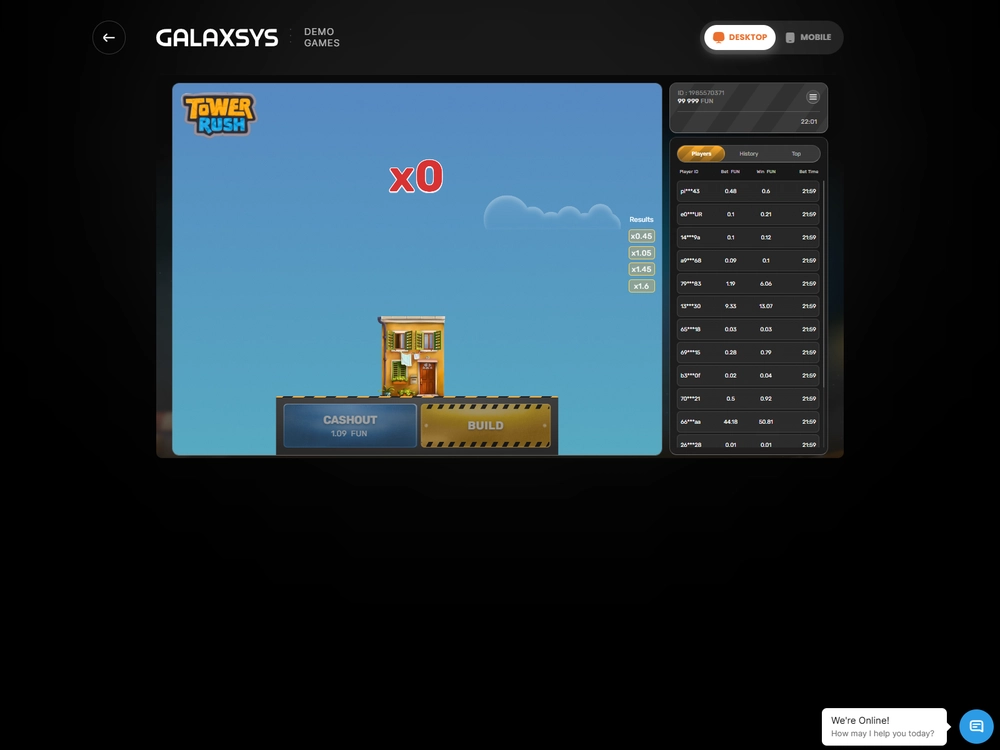
I completed four mobile-demo towers with a 100 FUN stake each. In the first, ×1.6 followed by ×1.45 produced 232 FUN. The second collapsed without Frozen protection. The next two returned 45 FUN and 38 FUN, demonstrating that a paid result and a profitable result are different outcomes.
| Round | Stake | Floor sequence or ending | Full payout | Net result | Balance after settlement |
|---|---|---|---|---|---|
| First | 100 | ×1.6, then ×1.45 and Cashout | 232 | +132 | 100,132 |
| Second | 100 | Collapse without Frozen | 0 | −100 | 100,032 |
| Third | 100 | ×0.45, then Cashout | 45 | −55 | 99,977 |
| Fourth | 100 | ×0.4, then ×0.95 and Cashout | 38 | −62 | 99,915 |
My total stakes were 400 FUN and total payouts were 315 FUN, leaving a net loss of 85 FUN. Three towers paid something, but only one returned more than its stake. Those four outcomes explain the accounting; they do not forecast the next tower or measure the game's theoretical RTP.
For the longer-term meaning of return and configuration differences, use the separate RTP and payout maths guide.
Read the amount in its current state
The number on Cashout is an available amount during the active tower, and it becomes a credited result only after settlement.
The mobile interface can display a 99,680 FUN balance alongside a 215.6 FUN Cashout amount. The button represents the tower's available payout. It is not already part of the displayed balance. Continuing the tower can change that amount before the eventual result is credited.
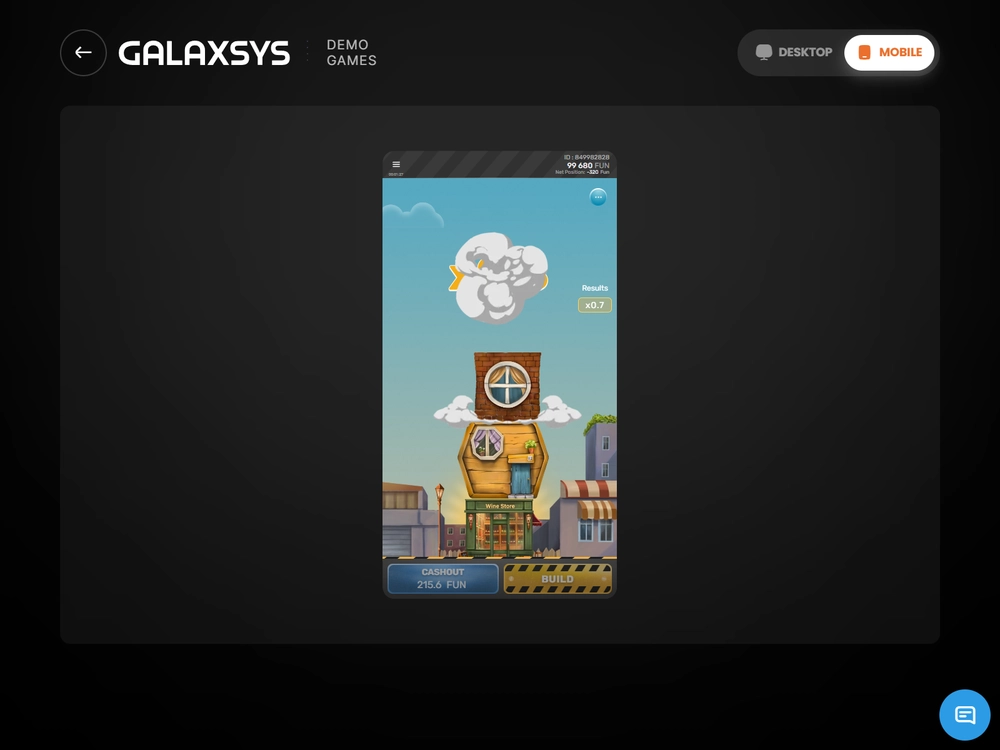
Use the round identifier to connect the active tower with its completed history entry, then check the single stake debit and single final credit rather than treating every changing button value as a separate payment.
In the first round of my four-tower session, the balance moved from 100,000 to 99,900 FUN after the stake, then to 100,132 FUN after the 232 FUN payout. The initial debit and final credit explain the +132 FUN net result without counting the returned stake twice.
FUN remains virtual throughout this process. My new independent demo session restored the starting balance to 100,000 FUN. That reset added 85 FUN to the previous ending balance, but it was separate from the 315 FUN paid by the four towers. No external money withdrawal comes from a FUN balance.
How Frozen and other bonus floors affect the round
Frozen Floor preserves the accumulated amount it freezes, while Temple Floor and Triple Build modify the tower before its final settlement.
All three features arrive randomly as floors that initially look ordinary; their bonus type is revealed after successful placement.
Frozen protects one amount until the tower ends
Frozen protection pays the frozen amount after a later collapse, or the larger amount if you continue and confirm a higher Cashout.
In my Frozen example, a 100 FUN stake had reached 500 FUN when protection activated. A later collapse still returned 500 FUN, giving a +400 FUN net result. In the higher-Cashout example, the protected amount was also 500 FUN and the final payout reached 1,000 FUN. The single credit was 1,000 FUN, giving +900 FUN net; the protected amount was not added a second time.
Tower Rush operator reviews
Six completed Bangladesh BDT tests. Scores and payment results reflect the tested accounts.
-

BDT access score7.15/10
- 96.55% configured RTP.
- 891 BDT received via bKash after a 9 BDT deduction.
-

BDT access score7.40/10
- 96.69% configured RTP.
- 1,900 BDT received via Nagad with no deduction after identity and address checks.
-

BDT access score7.15/10
- 96.19% configured RTP.
- 2,084.25 BDT received via Nagad after a 15.75 BDT withdrawal fee.
-

BDT access score7.15/10
- 97.00% configured RTP.
- 1,200 BDT received via bKash in 6 min 27 sec. The deposit had a 30.36 BDT external charge.
-

BDT access score7.40/10
- 96.65% configured RTP.
- 1,500 BDT received via bKash in full. The deposit had no external charge.
-

BDT access score7.40/10
- 96.33% configured RTP.
- 500 BDT received via bKash in full after identity and address checks.
Frozen can activate only once in a round. After it activates, further bonus floors stop appearing, and subsequent ordinary floors either succeed with a coefficient of at least ×1.5 or collapse. Protection belongs to that tower and does not carry into a new one.
Temple and Triple Build keep the same stake
Temple Floor gives one automatic wheel spin, and Triple Build places three additional floors automatically within the existing round.
Temple's wheel has 10 sections: nine numerical results and one Frozen result. A numerical result multiplies the current amount. In my example, 150 FUN became 225 FUN after ×1.5, with one final 225 FUN Cashout. The earlier 150 FUN was not a separate credit.
Each additional Triple Build floor has a coefficient of at least ×1. In my sequence, the amount before the three added floors was 120 FUN; ×1, ×1.5 and ×2 produced 360 FUN from the original 100 FUN stake. Neither feature created another stake debit. Both can occur again before Frozen imposes its restriction.
These floor effects are part of the tower's rules. Operator Free Bet and Free Amount promotions use separate betting rights or bonus funds. For the complete feature conditions and wheel outcomes, continue to bonus floors and features.
The 10,000 FUN ceiling does not end the tower
The official demo limits the full payout of one tower to 10,000 FUN, even if the uncapped calculation produces more.
In a ceiling example, an uncapped 12,600 FUN becomes an available payout of 10,000 FUN. The game displays a notification at the limit. You can technically continue building, but the payout cannot increase beyond that ceiling. A subsequent collapse without Frozen protection can still reduce the final payout to zero.
The maximum is an absolute amount: it equals 10,000 times a 1 FUN stake, 500 times a 20 FUN stake, or 100 times a 100 FUN stake. Treating ×100 as the universal ceiling for every stake would misread the rule.
Check the ceiling together with the currency label whenever you change modes, because these FUN limits do not establish the limits of an operator's BDT configuration or a cashier withdrawal.
What happens if the connection drops
A connection interruption after acceptance leaves the existing tower governed by its server state, so a frozen display does not establish a loss or a new round.
I restored the same round after an 18-second interruption. The test started with 1,000 FUN, deducted a 100 FUN stake and settled at 180 FUN, leaving 1,080 FUN. Reading the same response again left the balance unchanged. It did not create a second payout.
Restore the connection, wait for the existing state and inspect the matching history entry before submitting another initial Build; the session troubleshooting guide covers the recovery route in more detail.
If an accepted tower remains disconnected, the rules complete it after one hour of inactivity and credit its registered payout. In the inactivity example, 1,000 − 100 + 150 left 1,050 FUN. This completion rule does not turn a late manual Cashout into an accepted one: my request sent after server collapse was rejected, with no extra stake debit.
A software or equipment failure follows the applicable void rule: affected stakes and payouts are cancelled and the stake is returned. In my 100 FUN void example, the balance returned from 900 to 1,000 FUN. The refund restored the stake; it did not produce a 100 FUN profit.
Before your next Build
Use the official demo to follow one complete tower from accepted stake to history entry. Check the currency, read the available amount after each floor and distinguish the final payout from net profit. Tower Rush rules and gameplay become clearer when you track those state changes, including the point where Frozen protection applies.
For the wider game context and other topics, return to the Tower Rush guide.
Questions about a Tower Rush round
Do you pay again each time you press Build?
No. The initial accepted Build deducts the tower's stake once. Later Build actions continue that tower. A new stake is charged when you start a new accepted round, after the previous one has finished.
Can a successful floor lower the Cashout amount?
Yes. An ordinary floor coefficient below ×1 reduces the current amount. In my demo, a 100 FUN stake followed by ×0.45 paid 45 FUN when collected, leaving a 55 FUN net loss despite a successful placement.
Does Frozen guarantee a profit on every tower?
No. Frozen is a randomly triggered feature that protects the amount already accumulated when it activates. It does not promise to appear in a tower, guarantee that the protected amount exceeds your stake, or protect later rounds.
Can you withdraw FUN as BDT in Bangladesh?
No. FUN is the demo's virtual unit. Cashout transfers a settled virtual payout to the FUN balance; it does not send BDT to a bank or mobile wallet. An operator's real-money account and external withdrawal are separate processes.
Does the game stop automatically at its payout limit?
No. The demo ceiling limits the payout to 10,000 FUN, but building can continue. The amount cannot increase above the ceiling, and collapse still follows the round's protection rules.